
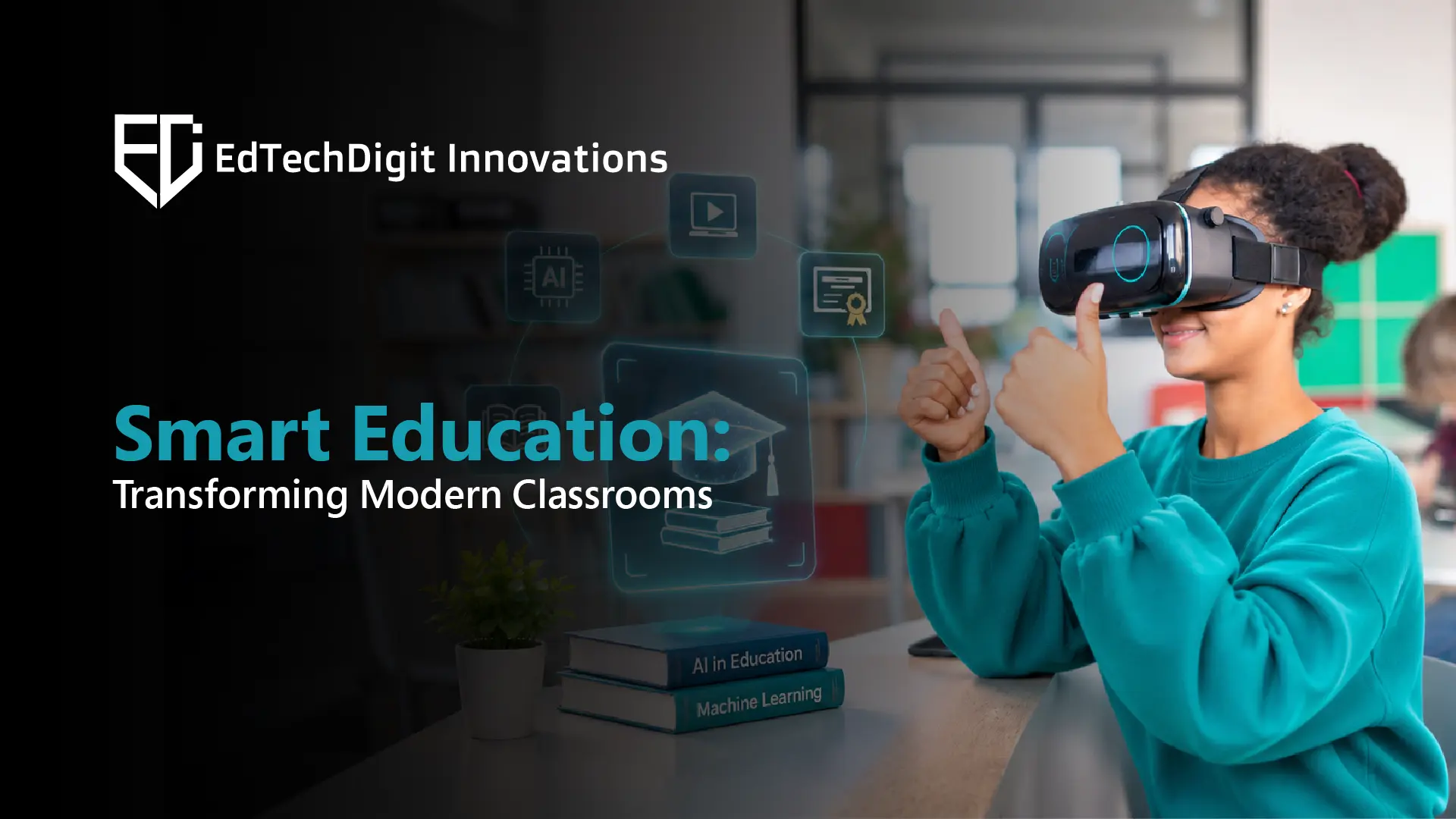
Today, almost all sectors are experiencing the accelerating requirement for digital transformation. Educational environments are undergoing a massive shift from traditional to dynamic, smart technological settings. Intelligent technologies in smart education have now moved from experimental ideas to the core foundation of the modernization of the education system. According to UNESCO’s recent findings, around 92% of higher education professionals use AI tools.
This read explores key insights into the smart education system, its core pillars, the role of smart technologies driving digitization, and how these technologies are impacting teaching and learning methodologies evolving to meet 21st-century needs.
What is the Smart Education System?
Smart Education means integrating modern technologies into the educational system, such as AI, analytics, and other tools, to streamline the overall learning process for learners by making it more personalized, flexible, and accessible. Did you know Gartner anticipated that by 2027, AI software spending in education would reach $13.2 billion at an 18.5% five-year CAGR?
So, let's uncover the 5 core, essential, interconnected pillars that define the smart learning environment:
- Emerging Smart Technologies: The technologies behind robust data analysis, easy access to digital education, and automation of administrative tasks are AI, IOT, Cloud, 5G Internet, etc.
- Smart Pedagogy: Application of innovative instructional strategies (smart pedagogy) designed to engage the audience and make learning simpler.
- Smart Learning: Student-focused learning methodologies that emphasize adaptability, personalized learning pathways, and more.
- Smart Learning Environments: All types of smart learning environments (physical, virtual, or hybrid spaces) are available to deliver educational experiences as per the learner's requirements.
- Smart Learners & Teachers: The education ecosystem today is well integrated with smart tools that help achieve personalized learning outcomes for each learner and enhance teaching delivery.
As we have covered the 5 core pillars of a smart education environment, now let's understand the 5 intelligent technologies in smart education that are working as a driving force in 2027.
What are the 5 Technologies Driving Smart Education in 2027
-
Artificial Intelligence (AI) & Machine Learning (ML)
Have you heard about Intelligent Tutoring Systems (ITS) and Adaptive Teaching Systems (ATS)? These systems simplify and speed up the delivery of personalized pathways, conduct pre-learning diagnoses, and automate collecting learner feedback, all because of AI and ML technologies.
-
Big Data Analytics
In the traditional education system, learners' learning behavior was tracked manually by collecting their data, but after the Big Data evolution, most of the data analytics tasks are automated.
-
Information and Communication Technology (ICT) & 5G
The core infrastructure that is the backbone of the smart educational ecosystem, consisting of AI, IoT, Cloud, and 5G technologies that will enable data analysis, connectivity, and automation.
-
Virtual Simulation Technologies (VR/AR/3D)
The virtual simulation technologies enable shifting learning from passive absorption to active exploration. It offers immersive 3D simulations to enhance engagement and retention and can be used in various fields, from STEM to medical training.
-
Cloud & Fog Computing
Cloud Computing provides a scalable, on-demand infrastructure as SaaS (Software as a Service), PaaS (Platform as a Service), and IaaS (Infrastructure as a Service). This ensures easy access to digital learning repositories and interactive tools anytime and anywhere.
How Intelligent Technologies Transform Teaching Methods
Smart technologies are changing the way teachers teach. Based on the research, here are three main teaching approaches that are enabled by intelligent technologies:
-
Differentiated Instruction: It is known that different students have different learning abilities and styles. Using smart technologies, teachers are empowered to group students dynamically, intervene them in real time, and custom-design instruction for different students using data analytics in such a way that they can get the right instruction they need.
-
Flipped Classroom: With smart technologies, teachers can push the passive part of the instruction, such as videos of lecture, outside the classroom and onto digital learning platforms, so that in-class time can be used to facilitate active learning, such as problem solving, working on projects, critical discussion, and providing personalized guidance to students.
-
Smart Online Instruction / Blended Instruction: Online learning is evolving. With semantic recommendation systems and multimedia interaction, learning platforms are able to provide a learning environment with no borders. Examples include language learning platforms that enable learners to interact with native speakers in real time.
Empowering New Learning Methods for Students
The intelligent technologies are student-centric in nature and drive several learning methods. They include:
- Personalized learning: Smart technologies help to deliver personalized content to a student based on their learning style, learning track record and current level of understanding. This enables learners to receive only relevant content and prevents information overload, resulting in higher levels of learning.
- Collaborative learning: Smart technologies help in grouping students intelligently, enabling peer learning, reflection, and problem solving, regardless of the physical location of the learners.
- Ubiquitous (U-Learning) and Mobile Learning (M-Learning): With smart portable devices and ubiquitous networks, the constraints of the physical classroom have been removed, and learning can happen anytime and anywhere, whether it is a formal or informal setting.
- Game Based Learning (GBL): Game Based Learning adds the elements of a game - an interactive, engaging, and stress-free environment to the learning process to enable learners to explore and become more active and creative in the process.
- Exploratory and context-based learning: Smart technologies enable simulation (e.g., VR/AR for emergency situations, science labs, etc.), where students can explore and discover complex situations in a controlled environment and hone their reasoning skills.
The Road Ahead: Challenges and Considerations
For a truly smart and inclusive education system, there are several issues that smart technologies have to overcome. These include, but are not limited to, equity and inclusion, which can only be ensured through well-considered policies. There is the issue of the alignment between smart technologies and sound educational theories as well.
In order to move into the future of education, research needs to continue to examine the roles of generative AI and the Edu-Metaverse as they continue to evolve and mature as cutting-edge technologies in the field of education.
Frequently Asked Questions
-
How is student data secured in a smart education system?
Student data is kept secure through the use of encryption and strict access controls, with compliance with GDPR and FERPA regulations to secure student analytics.
-
How are smart learning environments different from a digital classroom?
While digital classrooms simply digitize the content, smart learning environments take things a step further by incorporating AI and sensors to adapt to the needs of the students.
-
What is the need for adopting intelligent technologies in smart education?
High-speed Wi-Fi/5G connectivity, interoperable learning management system (LMS) platforms, and training for teachers are essential needs for the improvement of learning methodologies in schools and universities.