
Textbooks and traditional classrooms are outdated and are no longer effective in today’s world of education. It has become mandatory for educational institutes to leverage smart technology in education to stay competitive and relevant. The advancement in technologies and availability of various smart learning tools are redefining how students learn, collaborate, innovate, and solve problems.
From AI-powered platforms to immersive virtual environments, learning with smart technology has become more personalized as well as engaging. Schools around the globe are now leveraging such tools and technologies to modernize their education, improve student outcomes, and prepare them for the evolving job market.
Top 5 Smart Technologies Transforming Learning
Here are a few popular and widely used technologies in education, empowering both students and educators.
- Adaptive Learning Powered by AI
AI-powered online learning platforms can personalize course content and assessments, and provide feedback by analyzing student performance in real time. They can adjust the difficulty and recommend exercises to maximize learning outcomes.
For example, AI-based math and reading platforms in US school districts are helping students who struggle through customized lesson paths.
- Smart Interactive Displays and Digital Boards
Interactive smart boards are a great way to boost engagement in classrooms. Several schools that use digital whiteboards have reported higher student participation, especially in STEM subjects.
Schools across the Middle East and Asia use this smart technology in education to integrate videos, simulations, and live annotations. This makes lessons more dynamic and engaging.
- Virtual Reality (VR) and Augmented Reality (AR)
Though these technologies have existed for quite a long time now, integrating them with AI has made learning with smart technology more immersive and experiential. Medical students can practice simulated procedures, history learners can explore ancient civilizations virtually, and so on.
A secondary school in Europe showed that after integrating AR into their science modules, they significantly improved the retention rate, as students could visualize complex 3D structures instead of relying simply on textbook diagrams.
- Learning Analytics and Data Dashboards
Educational institutions are moving towards data-driven decision-making to make administration more effective.
For example, learning analytics platforms can collect insights on attendance, students’ performance, their engagement, etc., to identify at-risk students early and intervene on time.
Several public school systems already use analytics tools that have improved student progression rates through proactive academic support.
- Cloud-Based Collaboration Platforms
Cloud technology supports remote and hybrid learning environments and online learning platforms. Because of this, students can collaborate on projects in real time, share resources, and access/submit assignments from any device.
During the pandemic, educational institutes that adopted cloud-based learning management systems ensured they provided continuous education and minimal disruption.
These together are making learning with smart technology very convenient, engaging, and helping achieve better student outcomes.
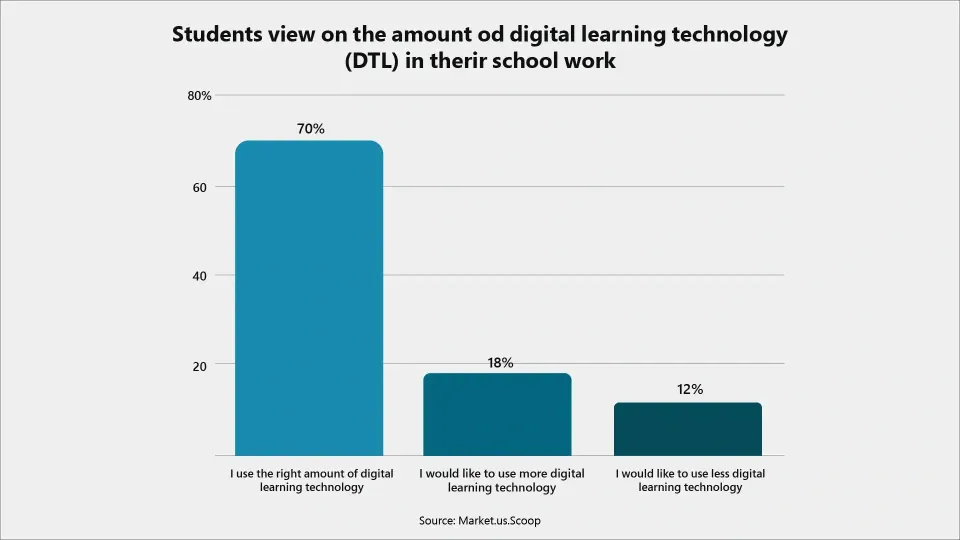
According to market.us, nearly 70% of students think they have access to the right amount of digital learning tools, but the majority of students feel they need more of them for a better learning experience.
How to Bridge the Accessibility Gap?
Using technology in education can also help reduce educational inequalities. Affordable internet, digital devices, and cheaper cloud-based platforms, especially for the education sector, are helping expand easy access to digital education to rural and underserved communities.
Moreover, partnerships with governments and non-profit organizations are also boosting the adoption of digital and smart technology in education by providing schools with essential resources like tablets or internet infrastructure.
Using technology for education also enhances learning experience for disabled students through tools like speech-to-text and other adaptive interfaces. So now, education is not limited to any geographical location or socioeconomic background; digitalization and smart technologies are making education accessible to everyone.
Preparing Students for the World Driven by Technology
The modern job market is evolving rapidly and demands extensive digital fluency, analytical thinking, and adaptability.
So, only modernizing the school infrastructure won’t help. Both students and teachers need to use AI tools responsibly. They need to know how to use tools, interpret data, or collaborate properly for maximum results.
Additionally, exposure to coding environments, robotics kits, and simulation tools further enhances creativity and problem-solving skills among students.
Integrating technology into daily learning will help schools prepare their students not only for exams but for an evolving job market that is becoming highly competitive, technology-driven, and shaped by automation and AI.
To sum up!
Smart technologies are definitely transforming education. Educational institutions that embrace and adopt technologies like AI, immersive tools, analytics, cloud platforms, etc., early will be able to significantly impact their students' learning journey, improve their administrative workflows, and thus, position themselves much ahead of their competition.
When thoughtfully implemented, these technologies can empower both students and educators and build a future-proof education system, producing an innovative, creative, and highly efficient future workforce.
Frequently Asked Questions
- Do smart technologies replace teachers?
No. Teaching is among the jobs that will be least impacted by AI and automation. However, educators must use it to enhance their teaching through insights, personalization, and interactive tools.
- Are smart classrooms expensive to implement?
Well, it depends. Cost can vary depending on what you want to implement. So, it is recommended to adopt scalable cloud solutions in phases to make implementation effective and manageable.
- How do smart technologies improve learning outcomes?
They personalize instruction, increase engagement, and enable timely interventions for struggling students.