
Traditional classrooms, which are built around static curricula and linear assessments, struggled to equip students for a world that rewards adaptability, critical thinking, and digital fluency. This widening gap between the learning systems and real-world skill requirements led to a fundamental demand for change in the education system and its frameworks.
This has led to the rise of Smart education, a more structured approach that uses technology to help in the process of modernizing today’s education systems and systematically building digital skills in education.
According to Fortune Business Insights, the global smart education and learning market is projected to reach USD 783.48 billion by 2027, and you might not find it more surprising that, looking further ahead, the U.S. smart education market alone is expected to reach USD 348.52 billion by 2032, indicating a long-term structural evolution rather than a temporary digital push.
What is Smart Education?
Let’s explore what smart education is and what the key factors are that are responsible for driving smart education in 2026.
Smart Education
Smart education is an integrated learning ecosystem in which digital technologies are combined with data intelligence and adaptive platforms to provide both personalized and measurable learning experiences. Unlike traditional education, it focuses on how learning objectives are defined, achieved, and evaluated throughout modern education systems.
A key strength of smart education is its alignment with structured goal-setting methodologies that bring clarity and accountability into learning design.
Key Driving Factors Behind Smart Education
Here are the major factors responsible for driving smart education in today’s education system.
1. Digital Transformation in Education
The adoption of smart education and digital tools is completely changing the way content is delivered to the students, evaluated by the teachers, and feedback is given to the institutions.
2. Government Support and Policy Initiatives
Digital classrooms, teacher upskilling, and technology-enabled learning models are becoming a top priority for all educational institutions today, which helps them get public funding and implement national education strategies properly.
3. Demand for Personalized Learning
All students learn at varying stages. Smart education makes good use of adaptive systems to personalize content and cater to diverse student learning needs within K-12 education systems.
4. Rapid Technological Advancements
Understand that Artificial Intelligence, virtual reality (i.e., VR), and cloud computing enable immersive, interactive, and scalable learning environments.
5. Global Connectivity
Modern internet infrastructure has normalized hybrid and remote learning, broadening access to smart education around the globe.
Impact of Smart Education
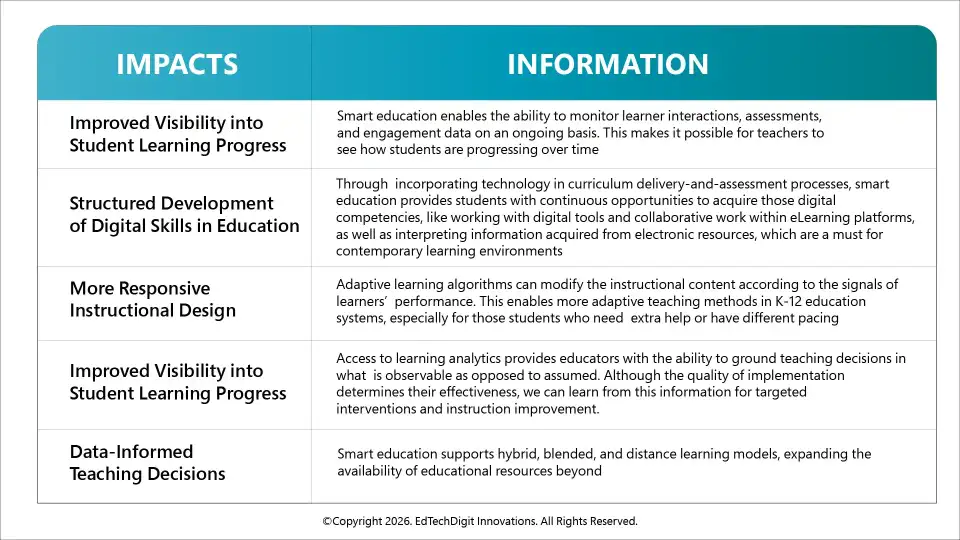
As per the Microsoft AI in education report (2025), students are using AI to brainstorm assignments (37%), summarize information (33%), and receive feedback (32%).
How Is Smart Education Reshaping the Future of Learning?
Now, let’s come to the main part. Explore next how Smart Education is transforming the future of learning in 2026 and beyond.
1. Re-orienting K-12 Education Systems Toward Workforce-Relevant Skills
Smart education is transforming learning by integrating K-12 education systems to changing workforce trends, including remote work, AI-mediated roles, and hybrid collaboration. In this respect, smart education also integrates digital tools and adaptive learning models to teach students educational digital skills that can be used when they step into the workplace in the future.
2. Making Personalization Operational Rather Than Aspirational
Utilizing AI-enabled platforms and data-driven strategies, smart education enables a more personalized approach for students while helping teachers. These systems adapt content according to the progress and learning pace of students, enabling K-12 educational institutions to address individual learning requirements better and preserve instructional integrity.
3. Enhancing Concept Understanding with Immersive Learning Experiences
Smart education uses technologies such as virtual reality and interactive digital tools to enable students to interact with difficult or abstract concepts in a more practical way. It leads to deeper investigation of the subject matter and helps in improving understanding, especially in technology-rich learning domains.
4. Strengthening Digital Skills in Education from an Early Stage
Through integrating digital literacy, online security, and technology behavior into the day-to-day learning process, smart education enables students to gradually form necessary digital barometers in their studies. This systematic exposure in K-12 education systems helps learners become responsible and efficient navigators of digital spaces.
5. Supporting Sustainable and Ethical Learning Ecosystems
Smart education promotes collaboration among educators, policymakers, and technology providers to ensure use that is safe, age-appropriate, and ethical. If applied intelligently, smart education helps improve efficiency in teaching and assist academic integrity building; it enables future-ready learning for today’s students while still keeping people involved in the educational process.
Did you know that around only 20 percent of children are getting an adequate education in the U.S., as per Forbes?
By this, we can understand that Smart education today is not just transforming the future of learning but also plays a vital role in enhancing the digital and professional skills of the learners.
Getting Ready for the Future!
Smart education answers the challenges introduced by outdated teaching models, skill gaps, and limited personalization. Today, the implementation of smart education is on the rise as the integration of technology and accountability into learning becomes increasingly necessary. It redefines how K-12 education systems prepare students for a better digital future. The shift is already underway, and it has shaped modern classrooms, curricula, and learning outcomes. Therefore, it is all on us: what we choose today, because it transforms our learning experience and learning outcomes.