
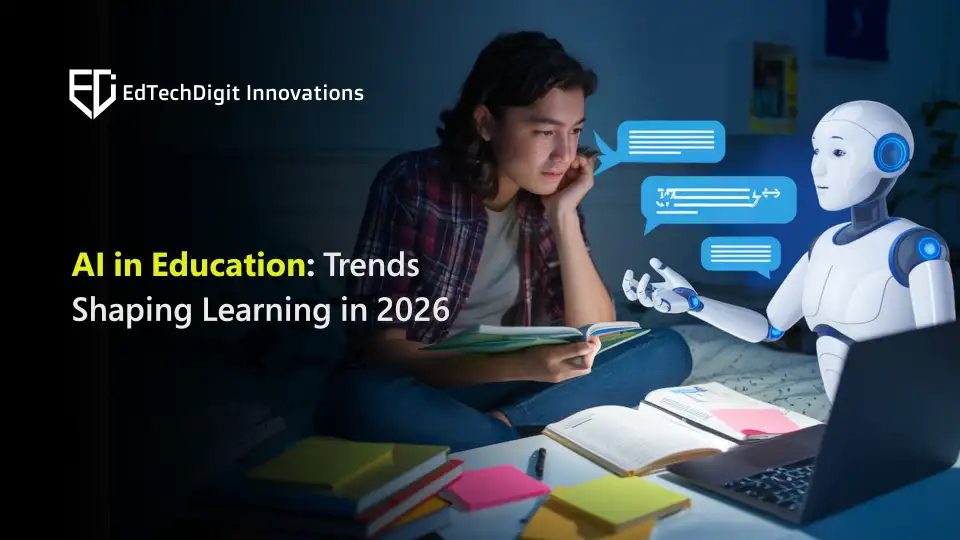
The way we view AI in education has undergone significant changes. Instead of debating whether AI should be used in schools, the focus is more on how effectively AI will be used. AI tools are now integral to education and are slowly transforming the way we learn as students, teach as instructors, and structure our education systems.
According to Microsoft's AI in Education report for the 2025 school year, nearly 47% of schoolteachers use AI tools daily. Most teachers and students have already used or have begun using AI-based technologies to assist them through the learning process.
Today's classrooms may not seem like something out of a science fiction movie, but what is significantly different is much more nuanced. The way we learn has become more flexible, our ability to receive immediate feedback from instructors is much greater, and our "learning paths" are more closely aligned with our individual student learning needs. The following blog will detail some of the primary trends redefining this next phase of learning.
Personalized Learning Has Become the Default
In 2026, personalization will no longer be an optional feature. Educational platforms now adapt in real time to how each student learns, not just how they perform in tests.
- Lessons adjust dynamically based on individual learning behavior and pace.
- Targeted practice activities are suggested when the learner is ready.
- Classrooms now support multiple learning paths instead of a single fixed curriculum.
- The focus has shifted from speed of completion to depth of understanding.
- Labels like fast or slow learners are becoming irrelevant.
- Students’ progress at their own pace, shaped by their unique needs, abilities, and experiences.
Classrooms Are Smarter, Not More Complicated
The smartest classrooms in 2026 aren’t the ones packed with technology; they’re the ones where it feels almost invisible. Much of what AI offers has already been established through the recent USAII® report AI in Education, Classroom Integration, and Impact in 2026. For example, many schools have begun using some forms of AI to help with student/advisor feedback.
AI also gives teachers a greater understanding of their students. Furthermore, it helps them make informed decisions about how to teach effectively without relying on their own experiences.
Assessments Focus on Progress, Not Pressure
In recent years, testing has been modernized with adaptive tests, as opposed to previously relying on tests with extreme pressure. Unlike traditional tests that do not measure and adjust for personal growth, adaptive testing provides a comprehensive picture of the student’s academic progress and development.
Adaptive Tests have been created to help students overcome their anxiety of failing a test. Teachers also benefit from an Adaptive Test by having a greater understanding of how a student learns. However, students can expect an Adaptive Test to provide a more holistic view of their progress than traditional testing methods could provide.
AI Learning Systems Power Continuous Feedback
Utilizing high-tech artificial intelligence learning systems will provide students with the ability to get instantaneous feedback from quizzes, assignments, and related written tasks.
Due to this immediate response to student work, there is an element of immediacy to the feedback. This allows students to reflect on and adapt their learning while the lesson is still being taught.
Teachers Have Gained Time, Not Lost Relevance
Teachers are not replaced by AI; in fact, teachers have taken on a more important role than previously thought. AI tools now manage repetitive grading or administrative tasks. This allows teachers to dedicate more of their time to mentoring students, facilitating classroom discussions, and providing emotional and social support.
In 2026, teachers act as the guide who uses insights from artificial intelligence to personalize their support of students.
Learning Extends Beyond School Hours
Learning in 2026 goes beyond just what is done inside the traditional classroom setting. Through the use of AI in education, students will be able to easily obtain access to classes, practice activities, and review materials while at home, at work, or anywhere else.
This flexibility is particularly beneficial for distance learning students, professional workers, and students of today who must juggle many different responsibilities.
Career-Aligned Learning Paths Are Clearer
AI-powered systems are helping students match their skills with current industry requirements. It also provides recommendations on which projects, certifications, or courses are suitable based on personal preference and future career aspirations.
Innovative AI systems enable educators to tailor and evaluate student progress in real time using cutting-edge technology. In 2026, these AI learning systems will be prevalent in many ways and represent some of the most influential innovations within education.
|
AI Tool or Platform |
Purpose |
How It Helps |
|
Smart Sparrow |
Personalized learning |
Modifies lessons based on each student’s learning pace, ensuring no student is left behind or disengaged. |
|
Century Tech |
Adaptive learning |
Identifies knowledge gaps and recommends targeted practice exercises and explanations. |
|
Squirrel AI |
Tutoring & skill mastery |
Provides AI-powered one-on-one tutoring to simplify complex concepts. |
|
Gradescope |
Assessment & grading |
Automates grading and delivers instant feedback, allowing teachers to focus more on mentoring. |
|
Querium |
STEM learning |
Offers step-by-step AI-driven problem-solving support in math and science subjects. |
Ethical AI Is Now a Core Priority
As AI becomes more common in an educational context, people are concerned about privacy and fairness. Institutions will increasingly take care of how they gather and make use of data in 2026. A few things that will be mandatory for all educational institutions are: Transparency, Consent, and Mitigation of Bias.
Implementing AI responsibly is an important element in establishing trust between students and the educational institutions, therefore allowing them to use AI learning systems without harming their due process rights.
What the Future Looks Like from Here
The future of education is not necessarily going to see more automation; instead, it will achieve a sense of balance between technology and human interaction. Classrooms will continue to be places where students can interact, discuss, create, and explore. They will be supported by artificial intelligence (AI) that will indirectly shape their learning experience.
Furthermore, certification programs from USAII® will enable everyone to acquire practical AI skills. The program will help bridge what happens in the classroom with what happens once they enter the working world.