
The most common issue in many classrooms today is that there are only a limited number of teachers, dozens of students, and they do not have enough time to clear all their doubts. Some students require additional assistance; some need help with challenging work; and many are too afraid to speak up.
These models aim to provide each student with a patient, personalized support system that allows teachers to reclaim many hours spent on grading, creating quizzes, and repeating the same explanation. According to Microsoft's 2026 AI in Education Report, 88 percent of educators have used AI for school. Which makes learning how to effectively utilize these LLM's is now considered an essential component of good teaching at both university and high school levels.
Large Language Models (LLMs) in Education
Large Language Models (LLMs) used for education are artificial intelligence (AI) systems designed to read, comprehend, and generate human language to assist with teaching and learning. LLMs have been trained on billions of examples of text; therefore, they can help explain concepts as if they were a patient tutor.
You may be familiar with some of these tools, such as ChatGPT, Claude, and Google's Gemini. The following is an easy way to understand how these tools differ:
- A search engine provides you with a list of links and then requires you to do the research yourself.
- An LLM reads your specific question and provides an answer using clear, everyday language.
What truly sets LLMs apart is their flexibility across different tasks. Because the same LLM can train a struggling beginner, challenge a smart student, and even help a university professor plan their lectures. While traditional software used to follow fixed, rigid rules, that made it do only the one job it was built for.
How LLMs Actually Work in Education
Now that you know what LLMs are, let's see how they work in education. Three built-in features make Large Language Models in Education especially useful for real classrooms:
- Everyday language: Students can ask questions in plain words, without hunting for perfect search terms.
- Conversation memory: The model remembers earlier messages, so follow-up questions get connected answers.
- Many languages: A university student can hear a physics concept explained in French, Spanish, or Arabic.
Where Do LLMs Show Up in High Schools and Universities
Those features turn into practical help once Large Language Models (LLMs) in Education reach classrooms and campuses. Here are the most common ways schools put them to work today:
- AI Tutoring: In high schools and colleges, students get stuck, and sometimes while doing self-study, they don't have anyone around who can help them; that's when they can utilize LLMs and clear their doubts at any time, from anywhere.
- Essay Feedback: University Writing Centers utilize LLM tools to identify poorly structured drafts prior to a tutor reviewing them.
- Quiz Building: In minutes, teachers create practice quizzes and rubrics from their lecture notes.
- Research Support: Prior to meeting with their advisors, graduate students summarize lengthy journal articles and test early ideas.
- Language Practice: Students in a French class are able to have real-time conversations with an AI partner that never becomes tired.
Benefits of LLMs for Students and Educators
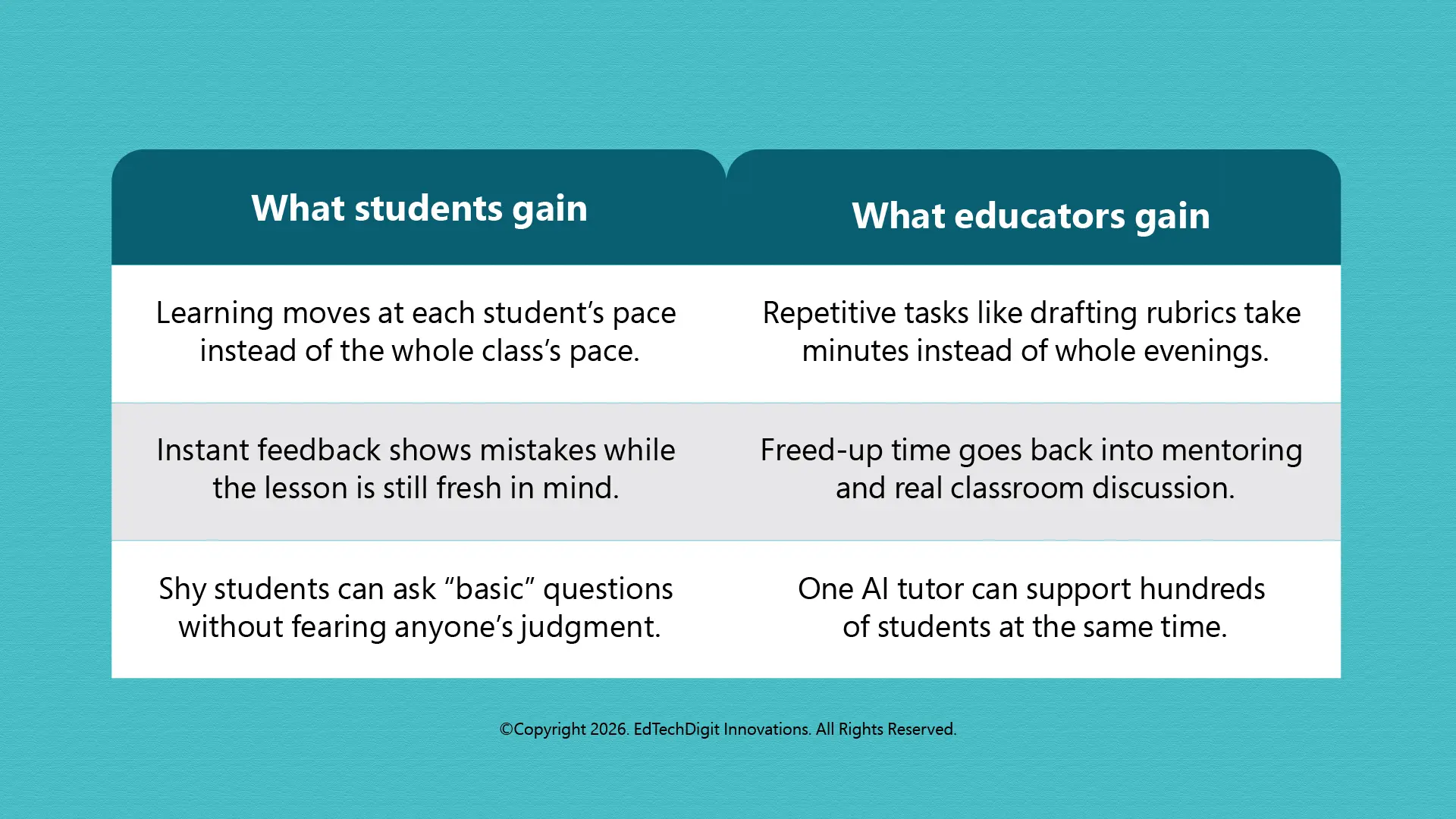
These everyday uses add up to real benefits for both sides of the classroom.
Large Language Models in Education have moved so quickly from experiment to everyday tool. Still, every powerful tool comes with real risks worth understanding.
Challenges Schools Cannot Ignore
The five issues that occur most frequently in actual classrooms include:
- Wrong Answers - Confident hallucinations can be slipped into essays, laboratory reports, and study guides without being noticed.
- Academic Honesty - Professors have difficulty determining if an essay is based upon a student's own thought processes or those of a chatbot.
- Skill Loss - Students who use AI to perform the difficult thinking will likely never develop the skills required to do so themselves.
- Privacy - Essays and grades are private information; therefore, schools must be aware of where this data is stored.
- Unequal Access - Some students purchase premium AI tools; however, many other students cannot afford them.
All of these issues do not indicate that schools should completely prohibit Large Language Models (LLMs) in Education. Rather, they demonstrate that access alone is insufficient, which makes literacy in leveraging these LLMs important.
<>How to Use the Smart Way?
The Digital Education Council's 2026 worldwide study revealed that 77 percent of university professors use AI in their classes. However, only 29 percent of students feel that their professors know how to help them with AI. This is where "smart habits" come into play. Smart habits will help close the gap between using AI and using it effectively.
Below are five smart habits that will address each of the challenges we discussed earlier:
- Teachers provide clear guidelines for AI usage in each syllabus. They specify which tasks can be done with AI, and which cannot be done.
- Students verify all critical information from a textbook, journal, or reliable website.
- Assignments require students to submit drafts, notes, and explanations of their reasoning, as well as final answers.
- Schools select educational versions of tools that protect student data and ensure its privacy. 5. Teachers demonstrate proper usage of AI by showing students how they evaluate and refine AI-generated responses.
Former U.S. Labor Statistics Chief Erika McEntarfer provided students with simple advice: treat AI like "a personal trainer, not a human forklift." In other words, the AI should help you get better; it should not do all of the work for you.
Final Thoughts
Today, what makes a big difference is how teachers use large language models (LLMs) in education to design assignments for students and how students use artificial intelligence (AI) to evaluate arguments rather than write them. These small, practical choices are what turn Large Language Models in Education into long-term skills.
Since the tools are going to change every month, you cannot learn everything about AI in one workshop. Teachers who continue to learn will be able to help their students, and students who practice using AI today will be prepared for future opportunities. Remember that the smartest classroom is highly AI-integrated, but the one that uses it most responsibly and thoughtfully.