
AI has moved well past the experimental phase in most classrooms, showing up in daily instruction rather than occasional pilot programs. IBM's 2026 survey of K-12 educators and parents, conducted in partnership with Morning Consult, found that 76% of middle school and 73% of high school teachers report that AI is being used in their classrooms at least weekly, yet only 20% of educators say they have received extensive training on how to use it effectively. That gap between adoption and readiness defines the space AI-powered LMS platforms occupy, systems designed to bring structure and personalization to how AI is actually used in daily instruction.
What Makes an LMS "AI-Powered"?
A conventional LMS operates in a passive way, mainly focusing on administrative tracking and content delivery. In contrast, an AI-powered LMS provides an additional dimension of decision-making that informs the software on how students interact with the material and changes their course of study based on that analysis rather than treating all students the same way.
Key AI Features Driving the LMS Platforms Shift
Four capabilities have become standard across most AI-powered platforms, each shaping how modern education actually works day to day.
Adaptive Learning Pathways
AI skillfully alters the order of the information that is given to students and determines the complexity and kinds of tasks to be done.
Through Machine Mnemonics
By analyzing how engaged the student is and how well he performs, the app uses the information to close the gaps in understanding.
Assessment with AI technology
AI can automate parts of grading, generate formative feedback, and adapt assessments to test specific knowledge or competency gaps.
Generative AI Learning Assistants
Large language models enable LMS platforms to deliver conversational, context-aware support, from explaining complex concepts and answering learner questions to summarizing course content and generating personalized practice.
Leading AI-Powered LMS Platforms and Technologies
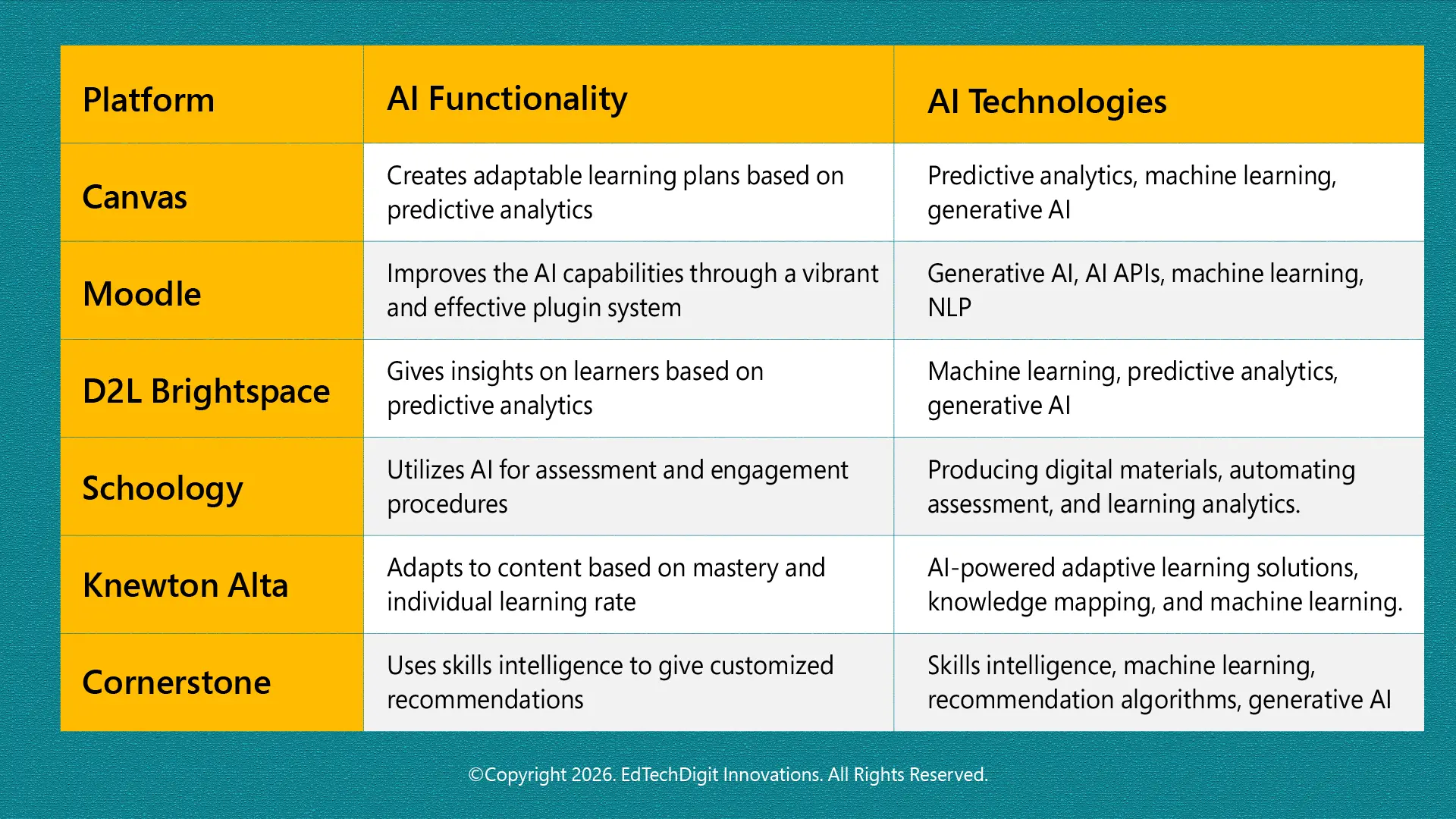
The AI-powered LMS market spans established platforms that layer AI onto existing infrastructure, alongside newer systems-built AI-first from the start. The table below highlights each platform's key AI capability.
As AI becomes more embedded in education, understanding how learner data is collected and used becomes just as important as the technology itself. EdTechDigit’s 2026 insight on data analytics in education explores how institutions are strengthening data governance and improving transparency around student data.
Challenges That Come with This Shift
Adopting AI-powered platforms introduces real tradeoffs institutions need to weigh deliberately:
- With these systems acquiring more fine-grained behavioral data, student data privacy becomes an increasing concern.
- Algorithmic bias continues to be a real concern since the system trained on historical data can create the same distortions that it aims to adjust.
- Policy has not kept pace with adoption; Deloitte's 2026 Back-to-School Survey found that while 28% of students already use generative AI in their schoolwork, only 33% of parents say their child's school has any AI guidelines in place.
AI-Powered Upskilling: Turning Learning into Workforce Readiness
Exposure to AI in the classroom doesn't automatically translate into workplace readiness. Structured upskilling closes that gap, giving students a defined path to build practical AI knowledge and demonstrate what they've learned.
USAII® addresses this early through two K-12 AI certifications, the Certified Artificial Intelligence Prefect (CAIP™) for grades 9–10 and its Advanced counterpart (™CAIPa) for grades 11–12, building a verified foundation in AI literacy well ahead of when these skills become expected in higher education and early careers.
What Comes Next for AI in Education
The next wave of shifts that will shape the future is likely to include the widespread adoption of parent-facing dashboards, the mandatory expectation that students complete AI literacy credentials at a grade level, and built-in tools to prevent shadow AI from proliferating.
As AI-powered LMS platforms mature alongside these shifts, the institutions that get ahead of all three will be the ones that turn this technology into genuine learning gains, not just another layer of complexity sitting on top of instruction that hasn't actually changed underneath it.
FAQs
Do AI-powered LMS platforms require extensive technical training for teachers to use effectively?
Most platforms are designed for minimal technical barriers, though interpreting the AI-generated insights well still benefits from dedicated training.
Are the grades given by AI grading tools similar when comparing math assessments to essays?
In mathematics, AI grading relies on rule-based response validation, whereas essays are graded using natural language processing (NLP).
Can an AI-powered LMS integrate with existing student information systems?
Yes, modern platforms can integrate with SIS, HR systems, CRMs, assessment tools, and other institutional technologies through APIs and connectors.