
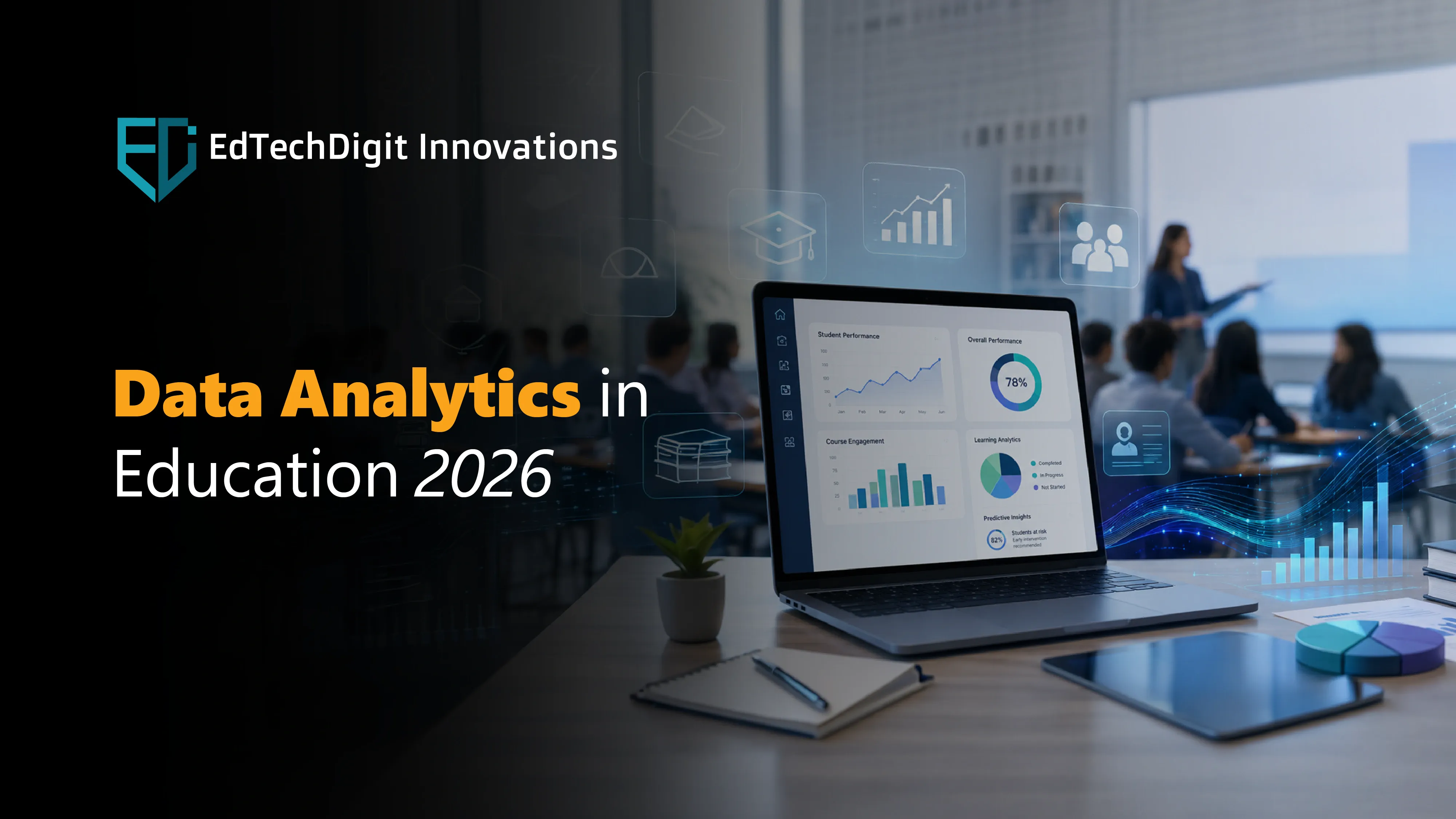
Education generates more data today than at any point in its history: attendance records, grades, engagement metrics, learning platform activity, and behavioral patterns. Most institutions collect this information, but very few actually use it, which is starting to change fast.
“88% of students and 77% of faculty are now actively using AI in their learning or teaching, up 16 percentage points from the year before.”
Digital Education Council’s AI in Higher Education Global Survey 2026
Data Science in Education is the practice behind that shift, turning raw data into decisions, catching a struggling student weeks before a report card would show it, or spotting a course that isn't working before enrollment drops.
Why This Matters Right Now
Every day, schools generate mountains of information: attendance logs, test scores, assignment submissions, login times on the learning portal, even how long a student lingers on a difficult question before giving up. Most of that data used to sit unused in some server, ignored until someone needed it for a compliance report.
”Only 10% of schools and universities had put any formal guidelines in place for using AI, and about 68% of urban teachers reported receiving no AI training at all and that's a striking gap.”
UNESCO
Adoption has outpaced governance almost everywhere, and institutions are largely making decisions about student data and AI tools without a real framework to guide them. This is exactly where Data Science in Education needs to catch up: not just collecting and using data, but doing it with the structure and oversight to back it up.
How Can Data Help Identify At-Risk Students Early?
The biggest advantage of analytics isn't the reporting dashboards. It's the ability to catch a problem while there's still time to fix it.
Catching Warning Signs Early
- A drop in attendance, a slide in grades, or a sudden pullback in class participation often shows up in the data well before a teacher notices it in person.
- Once flagged, counselors or advisors can step in with tutoring, a quick conversation, or extra support, instead of finding out weeks later that a student has already checked out.
Making Learning Feel Personal Again
- Not every student learns the same way, and pretending otherwise rarely works. Certain data science techniques, like clustering students by learning pattern or predicting where someone is likely to struggle, help teachers adjust pacing and material to fit the person in front of them.
- Some students need more visuals. Others need to work through problems hands-on. The data helps surface which is which, rather than leaving it to guesswork.
Keeping An Eye On Things As They Unfold
- Waiting until the end of a semester to see how students are doing is too slow. Ongoing tracking lets teachers see, week to week, whether a particular approach is landing.
- If something isn't working, it can be changed on the spot instead of after the damage is already done.
For a closer look at the data science techniques driving this shift, the United States Data Science Institute (USDSI®) has a detailed breakdown worth reading: How Does Data Science Revolutionize the Education Sector?
How Does Data Analytics Benefit Institutions?
It's not only students who gain from this. Institutions run more smoothly when decisions are backed by data instead of assumptions.
- Less time on repetitive admin work. Enrollment, scheduling, and reporting tasks that used to eat up staff hours can often be automated once the underlying patterns are understood.
- Smarter spending. Looking at which programs actually move the needle on outcomes helps administrators put money where it counts instead of where it's always gone by habit.
- Curriculum that keeps up. Course-level data shows which subjects are falling flat and where student interest is quietly shifting.
- Better retention numbers. Institutions that respond to data early tend to keep more students enrolled and moving toward graduation, rather than losing them along the way.
Differentiated Data Analytics For Higher Education and K-12
It's worth noting that this shift doesn't look identical everywhere. Higher education and K-12 education are dealing with different pressures, so the way analytics gets used tends to diverge.
Colleges and universities are mostly using predictive tools to manage retention across large, spread-out student bodies, forecast enrollment, and figure out which courses to keep offering. In K-12 education, the priorities skew more immediate: daily attendance, behavioral flags, and catching learning gaps in kids who may not have the words yet to say they're struggling. Different problems, same underlying idea: decisions grounded in data tend to hold up better than decisions made on a hunch.
What Technology Runs Behind Education Data Analytics?
None of this works without the right infrastructure. A few pieces tend to show up again and again:
- Learning Management Systems that track what students are doing and how engaged they are.
- Student Information Systems holding academic records, attendance, and the rest of the paper trail.
- Purpose-built analytics platforms designed specifically to model and predict outcomes in an education setting.
When these are properly connected, an administrator or teacher gets one coherent picture instead of five spreadsheets that don't talk to each other.
What Are the Challenges of Data Analytics in Education?
This isn't a frictionless process, and it's worth being honest about that.
- Privacy Concern: Student data is sensitive, and institutions have to take security and compliance seriously, not as an afterthought.
- Decision Making: If the numbers going in are wrong or incomplete, nothing built on top of them will be reliable either.
- Demand for Change: The staff who've done things a certain way for years. Training and a bit of patience go a long way here.
Final Thought
None of this is about replacing teachers or turning schools into spreadsheets. It's about giving educators and administrators the information they need a little earlier, so they can act before a small issue becomes a big one. Whether the focus is K-12 education or higher education, institutions that build this habit now are simply going to be in a better position a few years from today.