
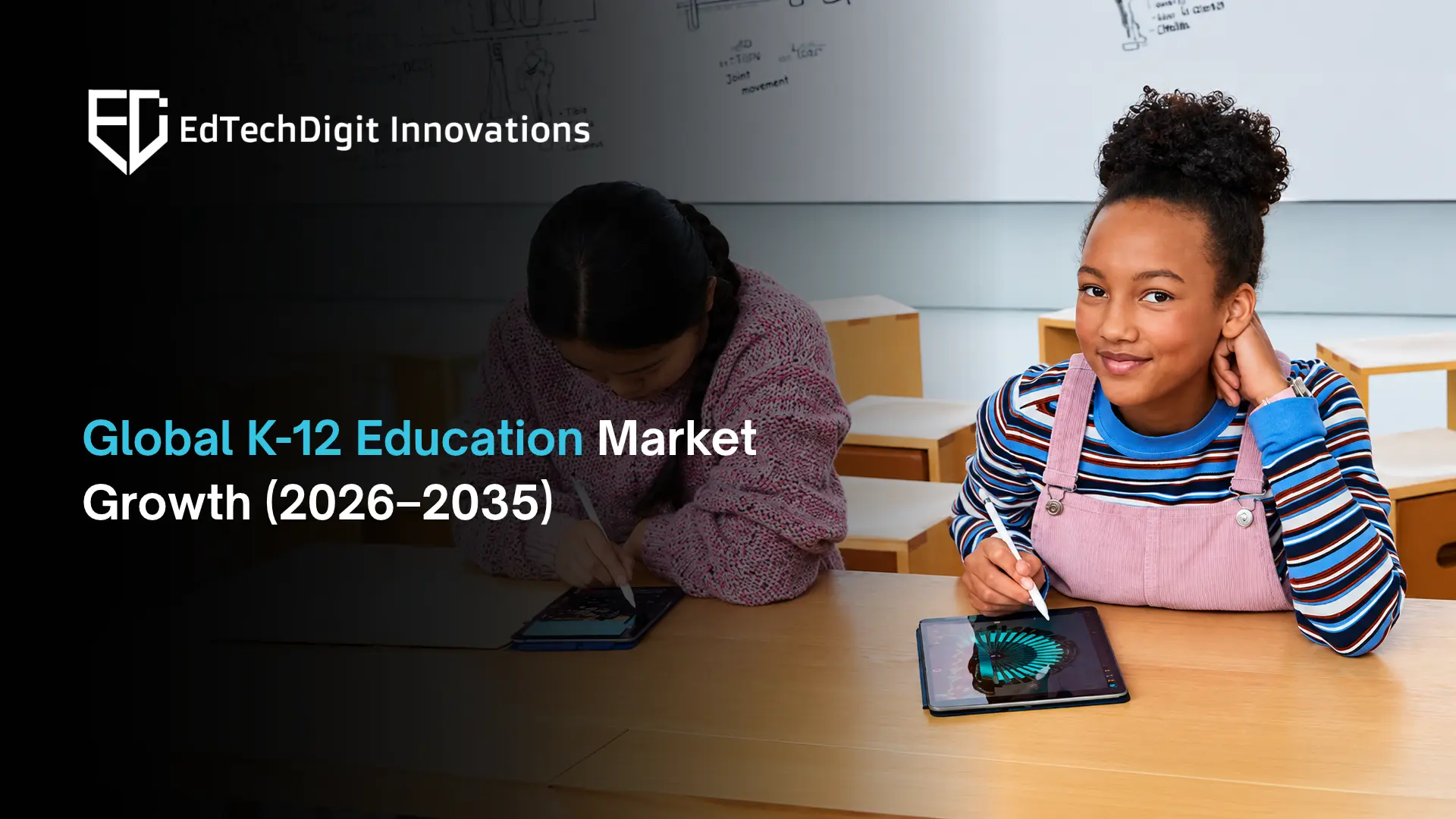
Rising demand for quality education is driving the global K-12 education market to expand. Investment in digital infrastructure and the growing integration of smart technologies in schools and universities are transforming how K-12 schools must deliver learning today.
The global K-12 education market in 2026 reached USD 3.2 trillion, and it is anticipated to reach approximately USD 7.7 trillion by 2035, at a CAGR of 10.2% from 2026 to 2035. At the 2026 International Day of Education celebrations, UN Deputy Secretary-General Amina J. Mohammed stated, “Education is one of the most powerful tools we have to transform the world.” Her message strongly highlights why investment in accessible, effective, and future-ready school education remains important for the development of K-12 education.
In the same light, let's understand the market's growth, major trends, and developments shaping global K-12 education.
Key Trends for Global K-12 Education Market (2026-2035)
There are several developments in K-12 education that are influencing overall investments.
- Digitalization and EdTech Adoption
Adoption of smart technologies is transforming how K-12 education manages both teaching and learning at scale. The digitization of educational platforms through the integration of smart technologies such as AI, machine learning, IoT, 5G, and data analytics helps schools and universities coordinate students' academic activities, assess their real-time learning outcomes, and make informed decisions to improve curriculum delivery.
According to IBM Newsroom 2026 report, almost 76% of middle school and nearly 73% of high school classroom educators admitted that AI is being used in their classroom at least weekly. Nearly 45% of school educators report that AI is used in the classroom daily or almost daily.
- Growing Student Population and Enrollment
The growing demand for school education and educational accessibility is directly linked to the rising population. The government is also investing heavily to increase the accessibility of education.
UNESCO shared in a recent report that the global enrollment in K-12 education has increased by 327 million students (30%) since 2000; it is now reaching nearly 1.4 billion students worldwide, which directly highlights the continued expansion of access to education.
- Demand for Personalized Learning
Every student's learning ability, interests, and academic needs are different from one another. This makes traditional classroom learning outdated compared with the current academic requirements of students.
Today, students want to enroll in courses that provide access to high-quality education and allow them to learn and complete the course at their own pace. With the integration of personalized and adaptive learning models, the progress of each student can be tracked easily, and these insights help teachers improve their learning approaches.
Synthesia's AI in Learning Development Report 2027 stated that 35% of respondents expect AI to create the most value by providing students with a personalized learning experience.
Global K-12 Education Market: Segment Analysis
We will examine the market across three major categories: institution type, real-world application, and learning delivery mode.
By Institution
- Public: Government-funded schools/universities.
- Private: Independent schools, specialized program providers with a varied curriculum.
The K-12 education market in the U.S. is expanding, with around 50 million students, 83% of whom are in public schools and 17% in private institutions. (Business Research Insights, 2026)
By Application
- Elementary (K-5): Foundational literacy, numeracy, and social skills.
- Middle (6-8): Subject development, STEM, and analytical skills.
- High School (9-12): College preparation, career guidance, and vocational pathways.
The U.S. has approximately 99,200 public schools, including about 68,500 elementary (primary) schools and around 30,700 high schools. (Research.com, 2026)
By Delivery Mode
- Offline: Classroom teaching and face-to-face interaction.
- Online: Digital lessons, resources, and flexible learning.
Did you know that both the offline and online global K-12 sector markets reached USD 3.51 trillion in 2026 (12.8% CAGR)? While offline learning delivery still accounts for over 96% of overall spending, online K-12 is a rapidly expanding subset. (Grand View Research, 2026)
Closing Thoughts
We have delved into the current state of the global K-12 education market in 2026 and its anticipated growth by 2035. The trends and segment analysis provided you with insights to gain a complete overview of what future development can lead to.
Today, we are in the era of spontaneous evolution in the education sector, as it is shifting rapidly from traditional learning to personalized modern learning after the integration of smart technologies that made it EdTech.
Keep upskilling and probing global K-12 trends and market expansions to stay informed!
Frequently Asked Questions
- What are the key trends in education expected to emerge in 2027?
AI-driven assessment generation and evaluation, skills-based learning, and screen time management to improve students' learning and well-being are some trends that can be expected in 2027.
- Which country has the best K-12 education system?
There are many countries that have strong K-12 education systems, including the U.S., but it still varies, considering the quality of education provided by the various institutions.
- What is the common problem with the K-12 curriculum?
Lack of teacher training, underfunding, and pedagogical misconceptions are three common problems with the K-12 curriculum.