
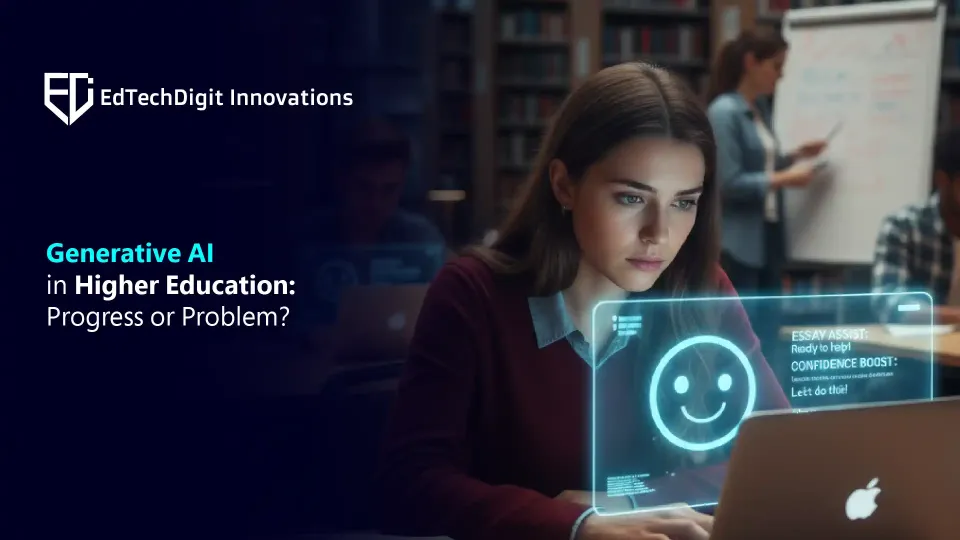
Suppose you have a task to complete. So, you turn on your laptop, enter a basic query into an artificial intelligence application, and in a few seconds, you have the answer. It looks perfect. It is well organized, concise, and presentable.
Pause and think critically, what if you did this task all by yourself and used your own brain?
Generative AI in Higher Education is not just a new technology. It is transforming the process of content creation, knowledge consumption, and skills evaluation. But as it is easily available, many students are completely relying on it. According to the Higher Education Policy Institute 2026 research, almost 95% of students say they use generative AI to help with assessed work.
The current generation of students desires quicker learning and assistance. Teachers desire results and more interaction. Meanwhile, the institutions are grappling with the issue of fairness, originality, and the actual meaning of education.
Therefore, the question is not whether AI ought to be used in education. It concerns the issue of how to utilize it in such a manner that it enhances learning rather than undermines it.
Generative AI in Higher Education
Generative AI is a category of systems that can generate new content, whether text, images, or code, according to patterns learned on large datasets. It not only provides information. It constructs human-like and context-sensitive responses.
This is the case in AI in Higher Education, where students and educators can now have access to tools that can transform routine academic work.
It is used in some of the following ways:
- Composing essays and assignments.
- Producing summaries and notes.
- Breaking complicated ideas down into simple terms.
- Helping with research and idea generation.
- Developing quizzes and learning resources.
This change is great as it makes work less demanding in the day-to-day tasks. Nonetheless, it also transforms the meaning of effort into the learning process. It becomes more significant when answers become easy to grasp.
What are the Major Advantages of GenAI in Higher Education?
Personalization of learning is one of the greatest advantages of Generative AI in Higher Education. Not all students learn in the same way, and the conventional systems seldom accommodate the needs of the students. Therefore, learning is more flexible and student-centered with AI.
Key advantages include:
- Individual learning pace where students are allowed to slow down or speed up depending on their comfort.
- Instant feedback that helps students correct mistakes immediately
- Interactive explanations and examples are more effective.
- Continuous support without time limitations.
- Better self-esteem since students are guided at their level.
This provides a learning atmosphere in which students are not passive consumers of information. They are actively involved and learn bit by bit.
Hidden Risks: Where Integrity Gets Challenged
The opportunities are impressive, but the risks cannot be overlooked. There are also serious concerns that come with the emergence of Generative AI in Higher Education, directly affecting the quality of learning.
The following are some of the most serious risks:
- Loss of critical thinking because students can use AI rather than think profoundly.
- Ethical concerns are due to the fact that AI-generated content is hard to identify.
- Cognitive offloading, in which the students transfer their cognitive processes to AI tools.
- Bias in AI results because of training data weaknesses.
These obstacles demonstrate that AI is not only a technical device. It is a framework that has a direct effect on equity, hard work, and authenticity in education.
How to Build a Strong Higher Education Framework?
Institutions require a clear Higher Education structure to deal with opportunities and threats. This model ought to inform the responsible use of AI within academia.
The powerful framework must concentrate on the following areas:
- Clear policies on the use of AI that clarify its use.
- Ethical work principles to promote fairness, transparency, and accountability.
- Reformulated tests, which emphasize thought rather than answers.
- AI literacy classes to educate students on responsible use.
- Training faculty to be able to implement AI in teaching.
This structure will guarantee that Generative AI facilitates learning rather than eliminates it. It also fosters confidence among students, teachers, and institutions.
Rethinking Assessment with Generative AI
Assessment design is one of the largest changes that is occurring in AI in Higher Education. The conventional tests and tasks are no longer sufficient to gauge real knowledge.
Institutions are shifting towards more significant evaluation procedures.
These include:
- Long-term assessments that involve long-term effort and creativity.
- Open-ended questions that are based on testing understanding rather than memorizing.
- Real-life issues and case studies that involve the use of knowledge.
- Oral tests and talks to determine the coherence of thought.
- Process-based assessment in which emphasis is laid on how the students come to their answers.
This change will make sure that, despite the use of AI by students, they will still have to fully interact with the generative AI content and use their own critical thinking to show actual expertise.
From Information to Intelligence: A Necessary Shift
Generative AI is forcing a major change in education. In the past, success used to be determined by the amount of information memorized by a student.
Now, information is easily available. Thus, the emphasis is on higher skills. Students are now expected to develop:
- Critical thinking
- Problem-solving ability
- Creativity
- Analytical skills
- Ethical decision-making
AI is not able to completely substitute these skills. They demand human judgment, reflection, and experience. This is the true worth of education in the AI era.
Core Area to Focus on Preparing Students for an AI-Driven Future
In order to be successful in this dynamic environment, students should learn to collaborate with AI and not rely on it.
The main areas of preparation are:
- The mechanics of Generative AI.
- Determining weaknesses and mistakes in AI results.
- As a support tool and not a replacement.
- Practicing knowledge in the real world.
- Being academically honest and original.
To gather sufficient expertise, a Generative AI Certification can be a good decision for learners who seek to become skilled in GenAI and develop practical AI knowledge, including ethical knowledge to maintain integrity.
Way Forward!
The debate on Generative AI in Higher Education is not going away in the near future. As a matter of fact, it is only starting.
The successful institutions will not be those that are merely adopting AI tools. Rather, it will be they who will have to redesign education in terms of thinking, creativity, and responsibility.
In the future, it will not be about usage anymore. It will be in the direction of mastery. To what extent can you integrate human intelligence with artificial intelligence to solve real problems?
That is the actual trial of today and tomorrow!