
The question for institutions is no longer whether AI belongs in higher education; it is how deliberately they are shaping its role. Lumina Foundation-Gallup 2026 State of Higher Education Study reveals that 57% of US college students now use AI in their coursework at least weekly, with about one in five using it daily.
Higher education has never faced a disruption quite like this one. AI is no longer a tool that institutions are debating whether to adopt; it is already embedded in how students learn, how faculty teach, and how universities operate. Let us discuss what that looks like across students, faculty, operations, and the road ahead.
How Students Are Using AI for Learning
Student AI use in 2026 is neither uniform nor simple. The HEPI Student Generative AI Survey 2026 found that 95% of students report using AI in at least one way, 94% use generative AI to help with assessed work, and 49% believe AI has improved their student experience, particularly by saving time, improving understanding, and providing instant support.
The most commonly reported use cases include:
- Research and information gathering.
- Drafting and editing written work.
- Exam preparation through practice questions.
- Organizing study schedules and managing workload.
How Educators Are Integrating AI Into Teaching
Faculty adoption is accelerating across higher education, with educators increasingly finding practical ways to embed AI into their teaching workflows without replacing the human judgment at the core of effective instruction.
Common ways faculty are integrating AI include:
- Generating formative feedback on draft work so students get useful input faster than a traditional marking round allows.
- Spotting learning gaps across a cohort and adjusting course content in real time rather than waiting until assessments reveal the problem.
- Building course-specific case studies, simulations, and scenario-based materials that would have taken days to put together manually.
- Supporting better planning of study programmes and workload management, both for faculty and for students navigating complex course structures.
AI Applications in Higher Education Operations
Beyond teaching and learning, AI is reshaping how universities run as institutions.
- Student support and retention through AI-driven early alert systems identify students showing signs of disengagement or academic struggle before they reach crisis point, enabling proactive intervention from advisors.
- Admissions and enrollment via AI tools are streamlining application review, personalizing prospective student communications, and improving yield prediction modeling.
- Research administration as AI is accelerating literature reviews, grant application drafting, and research data processing across university research departments.
- Campus operations by facilities management, scheduling, and resource allocation are increasingly supported by AI optimization tools that reduce administrative overhead.
Rise Of Generative AI And Academic Integrity
Academic integrity is the most contested dimension of AI in higher education in 2026. The core challenge is that the same tools students use for legitimate learning support can also be used to produce work that misrepresents their own understanding, and detection tools have not kept pace with generation tools.
Most institutions have moved away from blanket prohibition toward nuanced, assessment-specific guidance. The questions they are actively working through include the following:
- Which assessment types are appropriate for AI-assisted completion, and which require AI-free conditions?
- How should AI disclosure be handled, and what counts as sufficient attribution?
- What is the right institutional response when AI use crosses from assistance into substitution?
The institutions getting this right are those treating academic integrity as a pedagogical design challenge rather than an enforcement problem.
Perks and Challenges
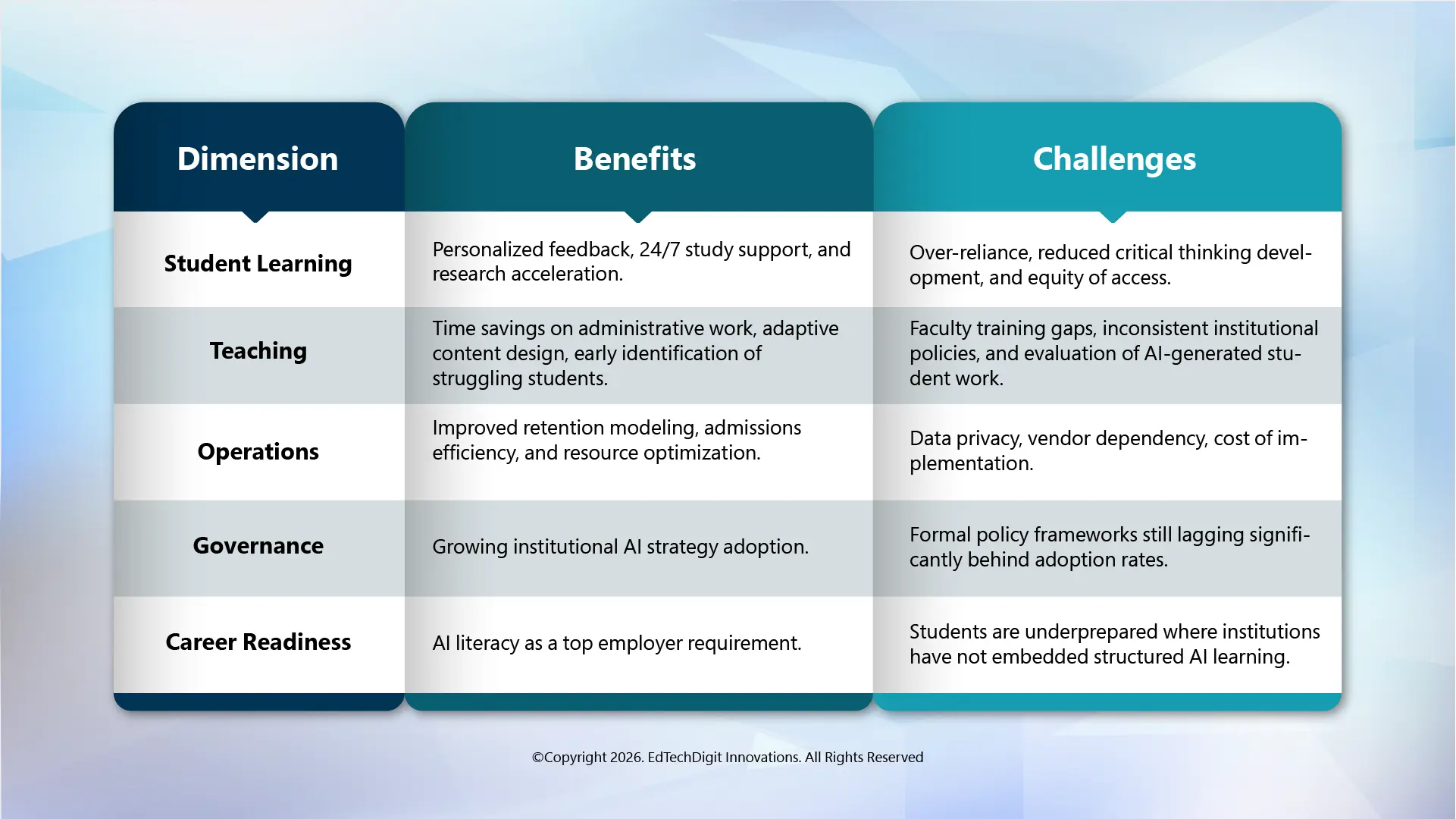
AI in higher education brings real gains across learning, teaching, and operations, alongside challenges. The table below maps both across the areas where AI is having the most impact.
Future of AI in Higher Education beyond 2026
Purpose-Built Educational AI
Purpose-built educational AI will replace general-purpose chatbots as the primary AI tool in institutional settings. The OECD's 2026 Digital Education Outlook recommends moving toward AI designed with intentional pedagogical purpose, tools that produce durable learning gains rather than simply producing outputs.
AI Literacy as a Core Graduation Requirement
AI literacy as a graduation requirement is already being discussed at the policy level in multiple countries. AI literacy is now the number one most in-demand skill on LinkedIn in 2026, and institutions that do not produce AI-literate graduates will face growing accountability for that gap.
Credentialing and Micro-Credentials
Credentialing will evolve significantly as AI compresses traditional degree timelines and employers shift toward skills-based hiring. Higher education institutions that build flexible, AI-integrated credentialing pathways will be better positioned to serve the workforce development market.
AI Governance as Regulatory Expectation
AI governance frameworks will mature from voluntary best practice to regulatory expectation as governments and accreditation bodies catch up with adoption reality, making early investment in policy infrastructure a strategic advantage rather than just a compliance obligation.
The Path Forward
The AI revolution is the present reality for the majority of students and a growing proportion of faculty. The institutions that treat this moment as an opportunity to redesign how learning works for an AI-augmented world will build a durable advantage. Those that treat it as a compliance problem to manage will find themselves perpetually behind.
The goal is not AI adoption. It is AI literacy, the kind that gives students genuine capability, critical judgment, and the confidence to work with AI as a tool rather than defer to it as an authority. For students in grades 9 to 12 looking to build that competency formally alongside their academic journey, USAII® K-12 AI certifications provide a structured, vendor-neutral pathway to validate knowledge and skills in today’s AI-driven world. Build AI skills early!