

In the current era, AI education is on a surge in the United States, even though Artificial Intelligence (AI) is no longer a niche subject taught in top higher education institutions or tech-related centers. According to a 2025 survey by Carnegie Learning, K–12 educators in 49 states and Puerto Rico are increasingly using AI tools like ChatGPT and Gemini to create teaching materials, personalize learning, and boost student engagement. While challenges like cheating and data privacy remain, more schools are implementing AI policies and training, reflecting the growing importance of AI skills in preparing students for the future.
Rapid Growth of AI Degree Programs
An overview of AI higher education in the past three years has been dramatic:
- Master’s programs: AI programs have now increased to 310 programs.
- Bachelor's programs: 193 courses currently exist in the AI or AI-related tracks.
- Program format: Approximately 53 percent of programs are independent AI degrees, and 47 percent of programs are AI-based or specializations within the larger programs, such as computer science, engineering, or mathematics.
This fast growth indicates that institutions of higher learning are accommodating not only the student demand but also the industry demands, providing for learners at various levels.
Which US States Lead the Regional trends?
The AI programs are distributed in the region as follows:
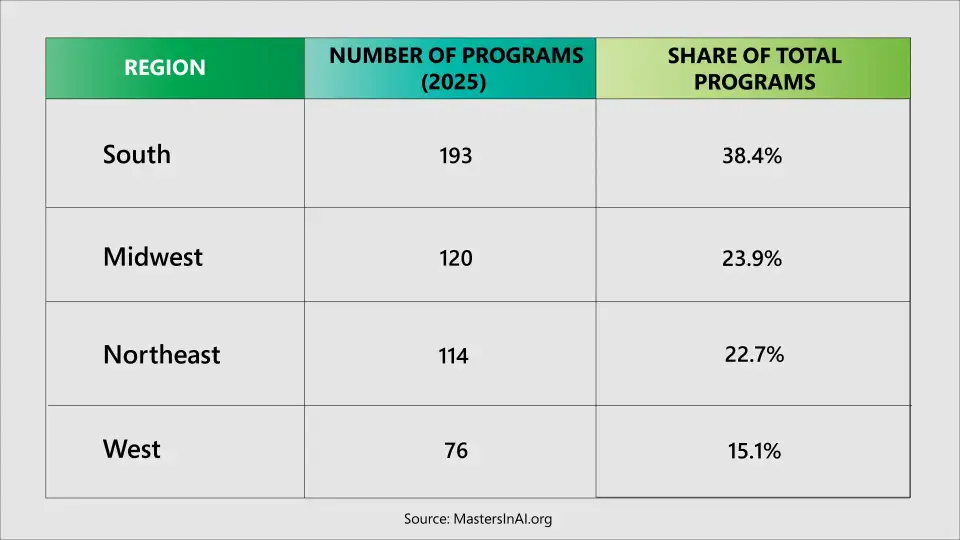
States such as Texas, Florida, and Georgia have been the major centers of AI programs and also the largest hubs in the South, which have significantly invested in AI research and education. The Midwest comes next, and some states like Illinois, Michigan, and Ohio are proliferating programs in universities and colleges.
New York, Pennsylvania, and Massachusetts still have a strong presence in the education of AI, which is often research-oriented. In the West, where there are tech giants in California, there are fewer-than-anticipated total programs, although the institutions there tend to have much more specialized or research-focused tracks.
Schools/Universities on the Front Runner:
Although hundreds of institutions provide AI programs, some schools have been distinguished in terms of program variety, research, and opportunities for students:
- Carnegie Mellon University (CMU): CMU is a highly recognized AI and robotics research institution and is regularly ranked among the best AI educational institutions, including undergraduate and postgraduate programs.
- Massachusetts Institute of Technology (MIT): Provides the most current AI programs with a strong interdisciplinary flavor that integrates computer science, engineering, and business.
- Stanford University: Bridges university research with industry connections in Silicon Valley, providing students with a view of the practical use of AI in practice.
- UC Berkeley: Has several AI-related programs, and its primary areas are deep learning, computer vision, and applied AI research.
- University of Michigan, Ann Arbor: Offers interdisciplinary AI courses in the fields of engineering, business, and applied sciences.
These institutions not only offer advanced coursework but also research opportunities, industry collaboration, and pathways into AI-driven careers.
Expanding Access Through Interdisciplinary Programs
A notable trend is the spread of AI programs beyond traditional computer science departments:
- Schools of Engineering: Concentrations in AI are becoming increasingly popular in electrical, mechanical, and industrial engineering majors.
- Business Schools: The programs are oriented to AI in analytics and decision-making as well as operations.
- Mathematics and Statistics Departments: Provide AI courses on data modeling, machine learning, and computational techniques.
This cross-disciplinary model will enable students with varied academic backgrounds to acquire AI, and this will increase the talent pool in industry and research.
Online Learning and Flexible Formats
The explosion of AI education is also an indication of the emergence of online and hybrid models of learning:
- Numerous master's programs are currently taking a full online format that accommodates working professionals, non-traditional students, and remote learners.
- Online AI courses give students an opportunity to acquire AI knowledge without moving or halting their careers, making AI education even more democratic.
This adaptability is particularly valuable because the skills of AI are now more required in non-technological industries, in the fields of healthcare, finance, logistics, and government.
What Does This Growth Means?
The AI education environment illustrates several main issues:
- Greater access: Areas in the U.S., distributed among different states and regions, now have access to AI education.
- Industry alignment: Through programs, graduates are trained to be able to work in a modern AI-driven labor market.
- Interdisciplinary opportunities: Non-CS students will be able to learn about AI, which will improve employability and the level of innovation.
- Ease of use: AI education with the use of online and hybrid formats can be made more available to a wider audience.
Such developments represent the fact that AI education is no longer exclusive to elite universities or tech-focused regions; it is spreading across the country.
Conclusion
As of now, U.S. states like Texas, Florida, and New York lead in AI education. Beyond traditional universities, certification programs from USAII® provide flexible AI learning for K12 students, undergraduates, and professionals, expanding access and practical skill-building. The landscape shows that AI education is now diverse, accessible, and evolving rapidly.