

Inside the school’s education systems, something fundamental is breaking. Neither the students are disengaged nor due to any lack of effort on part of the teachers. But, because the structure itself just cannot keep pace with advancement in learning in 2026 in terms of speed, complexity, and future expectations.
This is precisely the point where EdTech innovators in 2026 gain leverage. As per Infosys 2026 report, the K-12 segment from elementary and middle, to high school is expected to grow at a 3.5% CAGR. This means, adopting new strategies is no longer optional to keep pace with the technology-driven world.
They are not layering new tools on top of existing systems. They are reimagining learning as an adaptive, intelligent ecosystem that positions AI in education or other technologies such as cloud at the center of learner-focused infrastructure,not at the edge.
Top 8 Learning Strategies Schools Can not Ignore
-
Turning AI from Experiment to Infrastructure
The most notable change in 2026 is not adoption. It is integration. Education systems are transitioning from one-off pilots to full-scale transformation, with AI shaping:
- Learning environments
- Teaching workflows
- Decision-making systems
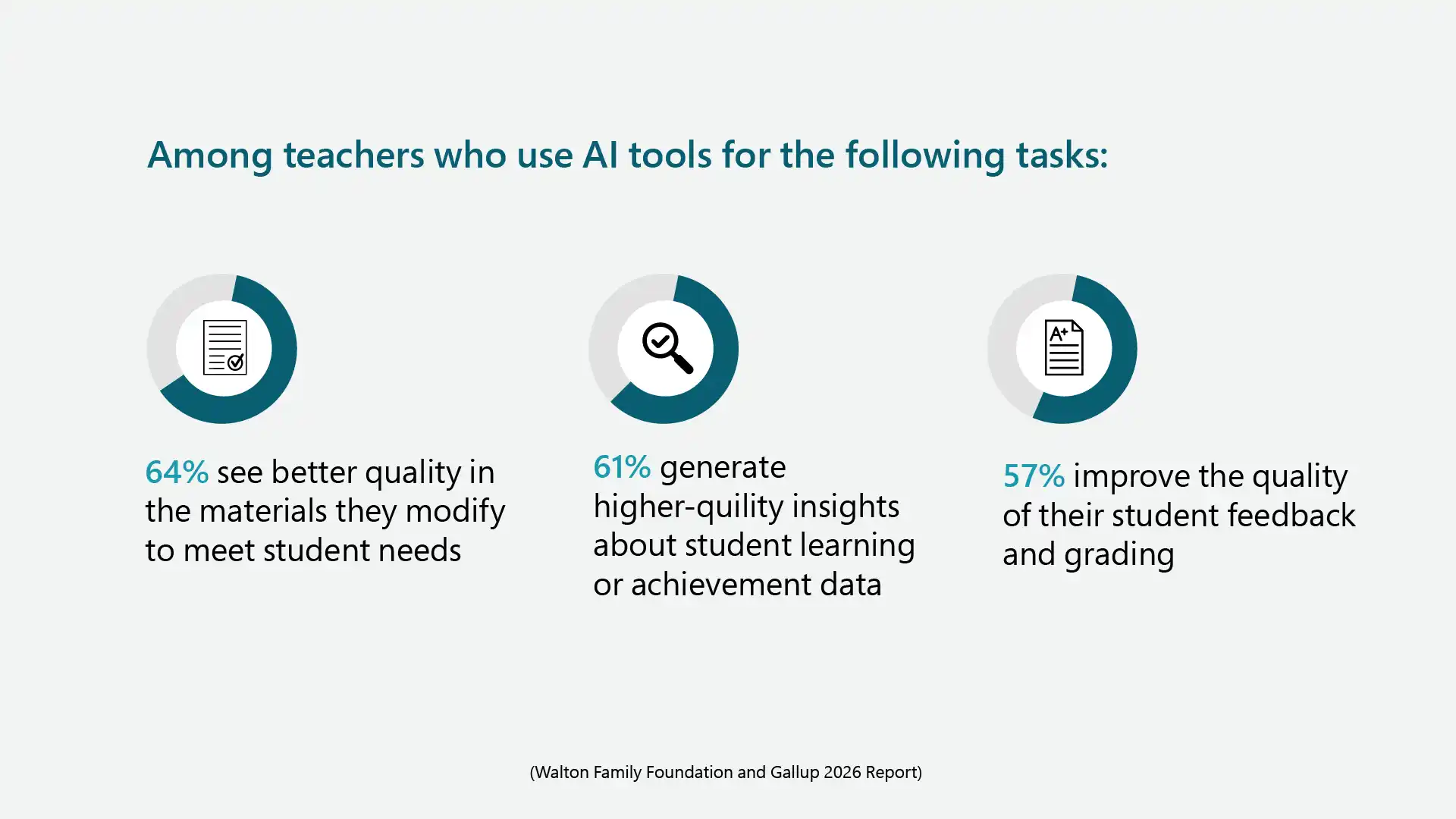
As you can see in the data above, this echoes global leadership thinking that the AI question is no longer whether we should use it, but how well it’s integrated into system design.
-
Replacing Fragmentation with Unified Ecosystems
Institutions have been running on siloed systems for years. That is changing.
Modern ecosystems now integrate:
- Learning platforms
- Student information systems
- Administrative and financial tools
It brings clarity and efficiency through this coherence. Institutions can now align learning outcomes to real-world pathways, which is increasingly becoming a competitive advantage across the global education sector.
-
Designing for Access Before Intelligence
If access is restricted, more advanced systems fail. Research consistently demonstrates that learners in low-resource contexts continue to face obstacles to digital education. That is why, in turn, leading institutions are prioritizing:
- Offline functionality
- Low bandwidth optimization
- Multilingual and assistive support
This makes it possible to deliver AI-driven personalization for every learner and not just those who are the most connected.
-
Building Cloud-First, Scalable Education Infrastructure
To retain and grow in this competitive market, organizations are ready to switch from traditional systems to cloud-native ecosystems. Over the past few years, the cloud computing in education technology (edtech) market size has emerged as an exponentially growing market. From $21.33 billion in 2025 to $27.88 billion in 2026, the Compound Annual Growth Rate (CAGR) will be a whopping 30.7%.
The best EdTech platforms now:
- Centralize data across departments.
- Scale without infrastructure constraints.
- Enable continuous updates without disruption.
SaaS– Cloud–based models have now formed the basis of many modern education systems, making it possible for institutions to be agile but firmly grounded.
-
Making Data Privacy and Compliance Non-Negotiable
Governance is essential as AI grows.
Today, education systems are subject to:
- Global regulations such as GDPR
- US frameworks such as FERPA, COPPA
- New models, such as the HEAT-AI model, for higher education
The best EdTech companies in 2026 are building compliance into the design of their systems using encrypted data flows and audit-ready governance. This enables ethical and reliable AI implementation.
-
Using Real-Time Analytics to Act Before Failure
Education is no longer a reactive process; it has become proactive.
Institutions now rely on:
- Real-time dashboards tracking learner progress
- Predictive analytics identifying risks early
- Continuous feedback loops improving outcomes
So, these systems enable educators to intervene before performance declines, making learning support timely and precise.
-
Delivering True Personalized Learning at Scale
Personalization is no longer theoretical.
AI-driven adaptive systems now:
- Personalize content according to the performance level
- Modify difficulty levels dynamically
- Provide targeted feedback instantly
Research demonstrates that these models enhance mastery by continually reshaping learning experiences. They also lessen educator workloads, while students become more engaged.
-
Expanding Mobile-First and Continuous Learning Models
Mobile access is often a key reason for all that online learning.
As smartphone adoption is worldwide, people have smartphones; therefore, institutions are accepting:
- Mobile-first design
- Bring your own device models
- Continuous access to learning platforms
This provides the opportunity to learn anytime and anywhere, creating a flexible learning environment that reaches everyone.
How Credentials Help in Innovating K-12 Learning?
Education and employment are getting more connected.
Institutions are moving toward:
- Micro credentials and digital badges
- Portable, verifiable skill records
- Industry-aligned certification pathways
Globally recognized certification providers such as USAII®, Microsoft, and IBM help learners in their future employment pathways.
Wrap Up
What we are observing is not a gradual change. It is converging.
Technology, policy, and learner expectations are all coming together at the same time. Together, these forces are necessitating a re-imagining of the functioning of education systems. This is already being led by EdTech innovators in 2026, who are building more connected and intelligent systems that adapt in the moment.
However, AI in education is not just about efficiency anymore. It is about unlocking greater decision-making, more potent learning outcomes, and fairer access.
Today, the education system is global, responsive, and increasingly integrated into real-world needs.
The future may not be perfectly determined. But one thing is clear: the institutions that create adaptability, trust, and accessibility today will determine how learning functions in the future.